

Brachiosaurus Bone
$19.00
Sale price
$19.00
Regular price
Skip to product information


Brachiosaurus Bone
$19.00
Sale price
$19.00
Regular price
Above: Front of Specimen Card
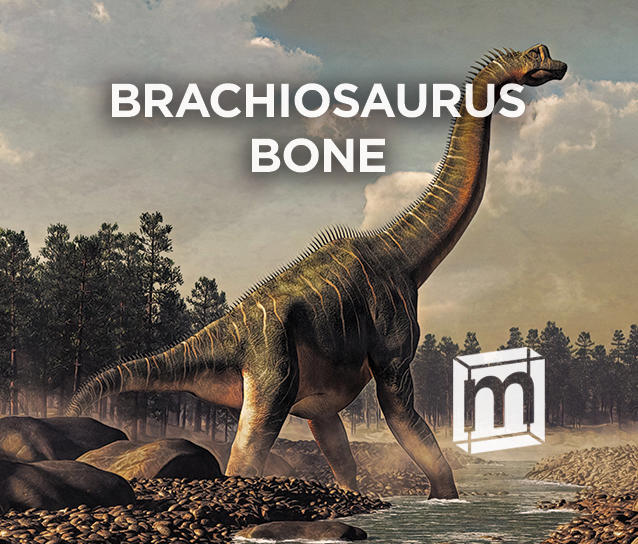
Known best for their powerful silhouette, Brachiosaurus roamed western North America during the Late Jurassic. With long necks reaching upwards of 9m (30ft) which sloped sharply towards muscular shoulders, this genus of towering sauropods grazed high and low from ginkgos, conifers, and large cycads.
This specimen is a fragment of Brachiosaurus femur from the Morrison Formation in Utah. Once thought to have been more widely dispersed, today the Brachiosaurus is known only from fossils found in the Morrison Formation of western North America. It first appeared in our Age of Dinosaurs collection and is now available as a single specimen.
The specimen comes inside a classic, glass-topped riker display case measuring 4 1/2" x 3 1/2". A small information card is also enclosed that also serves as the certificate of authenticity.
Please Note: The fragments vary widely by size and shape. They are roughly 1/2" (2cm) in size. We've stabilized this material but handle this one with care as it tends to be a bit crumbly.
More about Brachiosaurus
"This then was the giraffe among dinosaurs..."
~ Elmer Riggs, 1903, Paleontologist and the first to describe Brachiosaurus.
Even though it has been displaced by the titanosaurids, Brachiosaurus is still considered one of the heaviest dinosaurs, and their bodies experienced incredible physical stress. Unlike their relatively lighter distant cousins, the diplodocids, it is unlikely brachiosaurids reared much (if at all). However, their massive size would have placed them outside most predators' capabilities once fully grown.

An adult Brachiosaurus consumed an estimated 440 to 880 lbs (200 to 400 kgs) of plant matter daily, spending about 2/3rds of its day eating. They could consume quite rapidly since sauropods did not chew; as indicated by their teeth, they instead relied on their gut for digestion. Although fossils have not been found in great numbers, brachiosaurids probably moved in herds to areas of fresh vegetation as they cleared areas.
Their skull's distinctive nasal openings placed above the eyes originally led paleontologists to believe that the nostrils were located at the top of the head, but that has come under debate versus a more traditional tip-of-snout placement. Either way, Brachiosaurus possessed some sort of nasal crest, possibly ornamental.
In 1903, Elmer S. Riggs received the naming honor for a partial postcranial skeleton discovered in 1900, and gave it the name Brachiosaurus altithorax. However, in 1883 Othniel C. Marsh had misclassified a sauropod skull, thinking it was part of an Apatosaurus (known at the time as Brontosaurus). Paleontologists now know Marsh's sauropod was the initial Brachiosaurus find.
 Above: Back of Specimen Card
Deals on this item:
• Free Shipping on $50+.
• Get 20% off your first order when you sign up for our newsletter.
• Matter subscribers, don't forget to use your 15% storewide discount on every order.
Your Purchase Does More:
Science Education Programs: Every purchase helps fund our guest lectures, science fairs, and community science clubs — bringing real scientific literacy to curious minds of all ages.
Sustainable Small Business: We partner with agroforestry and carbon capture organizations to keep our entire emissions footprint net negative — not just neutral.
Independent Researchers: We source directly from active research labs, so your purchase puts money back into the hands of working scientists.


