

Rough Sapphire
$18.00
Sale price
$18.00
Regular price
$19.00
Skip to product information


Rough Sapphire
$18.00
Sale price
$18.00
Regular price
$19.00
This specimen first appeared in the Fourth Edition of the Mini Museum. We are pleased to offer it once again as a single item!

Above: Front of the Specimen Card
Dazzling and durable, sapphires are among the most popular gemstones in the world. This specimen is a rough sapphire from Myanmar’s Mogok Metamorphic Belt, also known as the "Valley of Gems."
The specimen is housed in an acrylic jar that is encased within a glass-topped riker display box. The box measures 4 1/2" x 3 1/2". A small information card is also included, which serves as the certificate of authenticity.
Please Note: Colors vary widely on this specimen, from dark to light blue.
About Sapphires
"Beauty is meaningless until it is shared." ~ George Orwell, Burmese Days, 1934
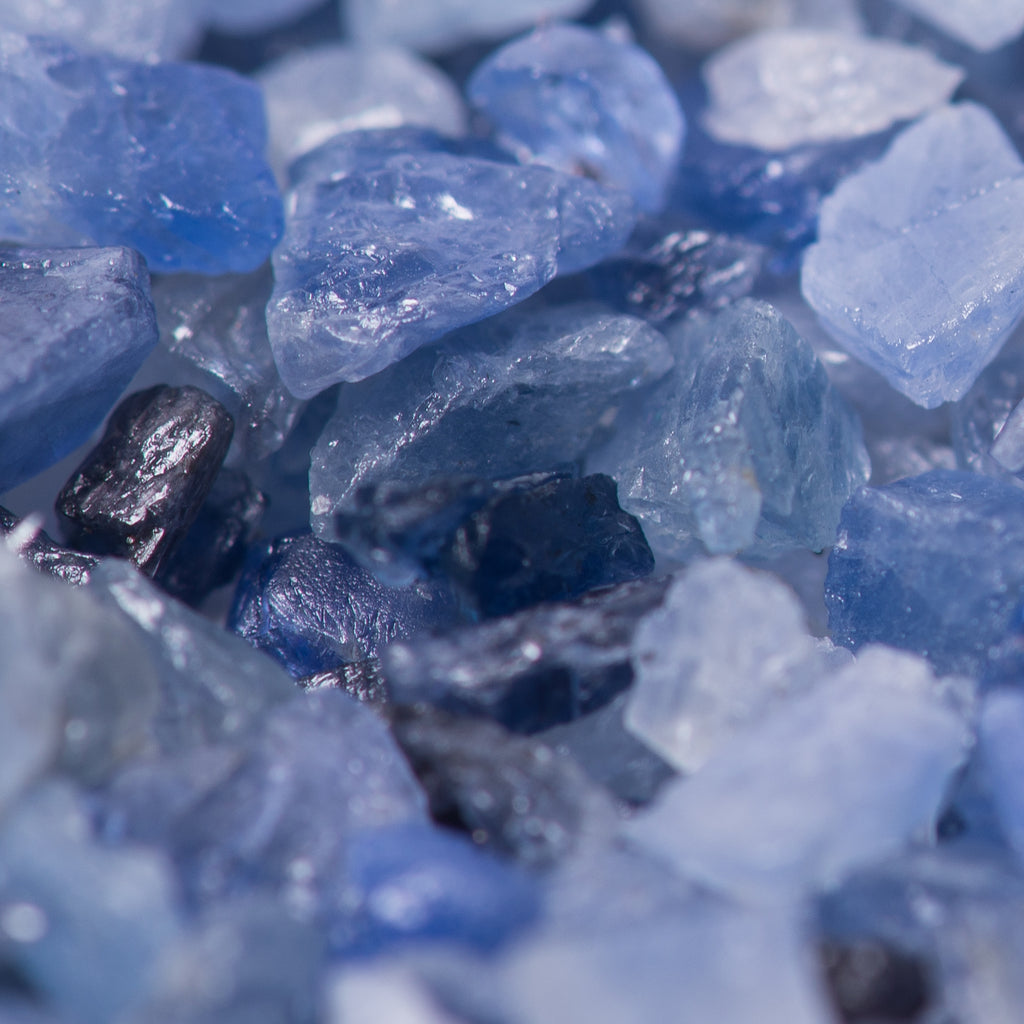
Above: Rough Sapphires from the Mini Museum Collection.
Sapphires form very slowly inside cooling igneous and metamorphic rocks as metals seep into aluminum oxide crystals. Also known as corundum, the crystals are transparent on their own, but the presence of different metals lends unique colors to the final stone. Traces of titanium result in a blue hue while the presence of iron results in the color yellow. Any color except red is considered a sapphire, while red, indicating the presence of Chromium, is considered a ruby.
Most sapphire is recovered from placer deposits. This occurs where the softer host rock is weathered or eroded to the extent that these crystals are separated. They have a high density of 4.0 (specific gravity) and can be recovered from alluvial materials derived from their original host rock, in a similar manner to gold placers.

Above: Mining in Mogok. Extraction methods include a combination of alluvial mining, open-pit mining, and carving caves and tunnels in solid rock. (Image Credit: Olivier Goujon / Le Pictorium)
This particular specimen comes from Myanmar’s Mogok Metamorphic Belt, also known as the "Valley of Gems." Stretching over 930 miles (1500 km), this region has yielded some of the world’s greatest rubies, jade, and sapphires.
Sapphires can command some of the highest prices paid for any gem. In 2009 a 16.65-carat Kashmir sapphire was sold for $2,396,000. The market to obtain a quality sapphire is complex. From the time a rough and first-generation cut gem is sold it will travel through many buyers and dealers at different levels depending on its quality. A sapphire's value will also be related to a ceiling dictated by comparable gems (size, color, clarity).
Natural sapphire can exhibit asterism or "stars" on surfaces of stones with round-cut surfaces, known as cabochons. The "stars" are caused by light reflecting off tiny inclusions of the mineral rutile, or other iron or iron-titanium oxide minerals, which have grown within the crystal and are aligned parallel to the hexagonal faces at 60 degrees. The light reflects along these crystallographic planes.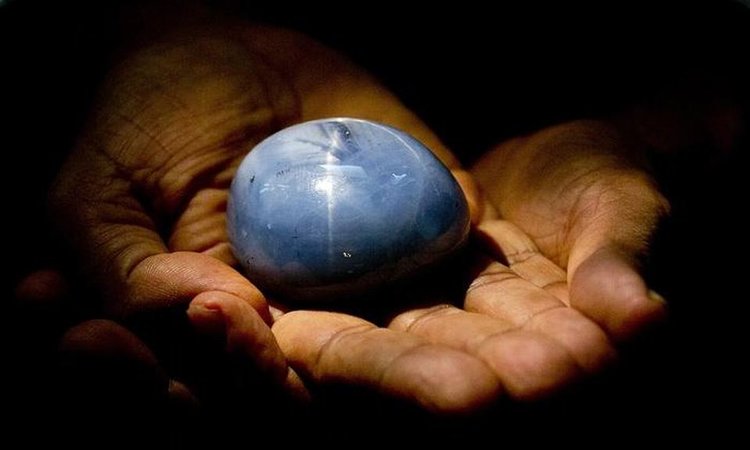
Above: The Star of Adam, currently the world's largest star sapphire.
The Star of India is perhaps one of the most celebrated star sapphires in the world. It is considered almost flawless and displays stars on both sides. The Star of India was found in Sri Lanka and first exhibited to the public at the Paris Exposition of 1900. During the 1960's it was stolen and subsequently found and returned to the American Museum of Natural History where it presently resides. The largest star sapphire in the world is the Star of Adam. It weighs 1,404.49 carats and is valued at over $300,000,000 USD.
Further Reading
Giuliani, Gaston, et al. "Oxygen isotope composition as a tracer for the origins of rubies and sapphires." Geology 33.4 (2005): 249-252.
Groat, Lee A. "Gemstones". American Scientist. 100 (2012): 128-137.
Chatterjee, Kaulir Kisor. Uses of Industrial Minerals, Rocks and Freshwater. New York: Nova Science Publishers, Inc. 2009.
Mason, Brian and L.G. Berry. Elements of Mineralogy. San Francisco: W.H. Freeman and Company, 1968.
Themelis, Ted. Mogôk: Valley of Rubies & Sapphires. 2000.

Above: Back of the Specimen Card
Deals on this item:
• Free Shipping on $50+.
• On sale: Save 5% off the regular price.
• Get 20% off your first order when you sign up for our newsletter.
• Matter subscribers, don't forget to use your 15% storewide discount on every order.
Your Purchase Does More:
Science Education Programs: Every purchase helps fund our guest lectures, science fairs, and community science clubs — bringing real scientific literacy to curious minds of all ages.
Sustainable Small Business: We partner with agroforestry and carbon capture organizations to keep our entire emissions footprint net negative — not just neutral.
Independent Researchers: We source directly from active research labs, so your purchase puts money back into the hands of working scientists.


